Most people visiting a treatment center website have already pushed through a lot of resistance just to start looking. What they find shapes what happens next..
I analyzed 85,409 pages from 4,957 behavioral health providers to understand how the industry communicates with people at their most vulnerable moments. What I found was interesting: the vast majority of behavioral health content is clinically accurate but emotionally absent.
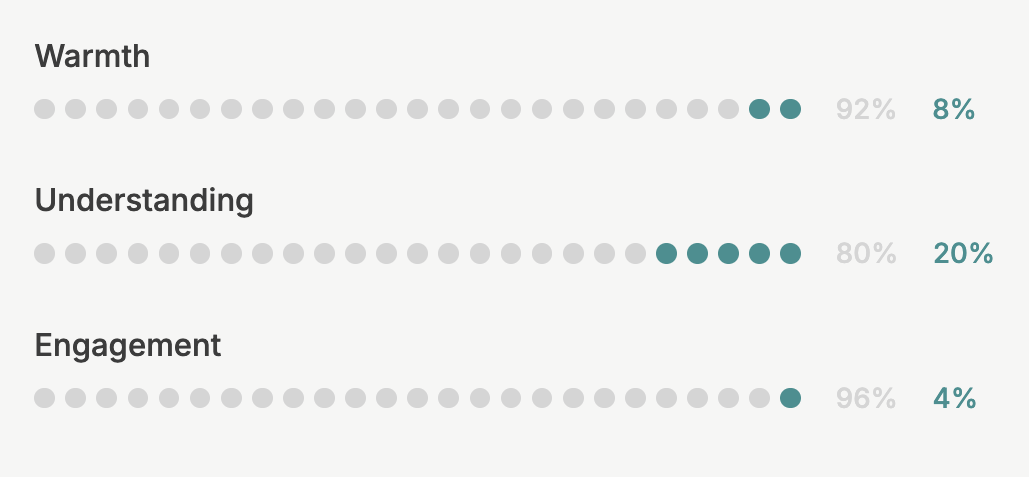
92% of behavioral health pages show no emotional warmth.
Nine out of ten pages from treatment centers, therapists, and recovery programs fail to express the kind of compassion that people desperately need when they’re considering getting help. And warmth is just one dimension of empathy. The picture gets worse from there.
This isn’t about criticizing providers who do meaningful, life-saving work every day. It’s about a disconnect between the care that happens behind closed doors and how that care is communicated online. Providers talk about “compassionate care” in their taglines while their actual content reads like a medical textbook.
The good news? This is fixable. Empathy isn’t a feature you need to build. It’s a writing choice you can make today.
Methodology
This analysis used the empathy measurement framework from Sharma, A., Miner, A.S., Atkins, D.C., & Althoff, T. (2020). “A Computational Approach to Understanding Empathy Expressed in Text-Based Mental Health Support.” Proceedings of the 2020 Conference on Empirical Methods in Natural Language Processing (EMNLP). The framework was applied to 85,409 pages from 4,957 behavioral health providers. Validation F1 scores: Emotional Reactions 0.81, Interpretations 0.80, Explorations 0.93.
Three Signals of Empathetic Content
To measure empathy at scale, I used a peer-reviewed framework developed by researchers at the University of Washington and published at EMNLP 2020. The framework was trained on 10,000 human-annotated mental health conversations and identifies three distinct dimensions of empathetic communication:
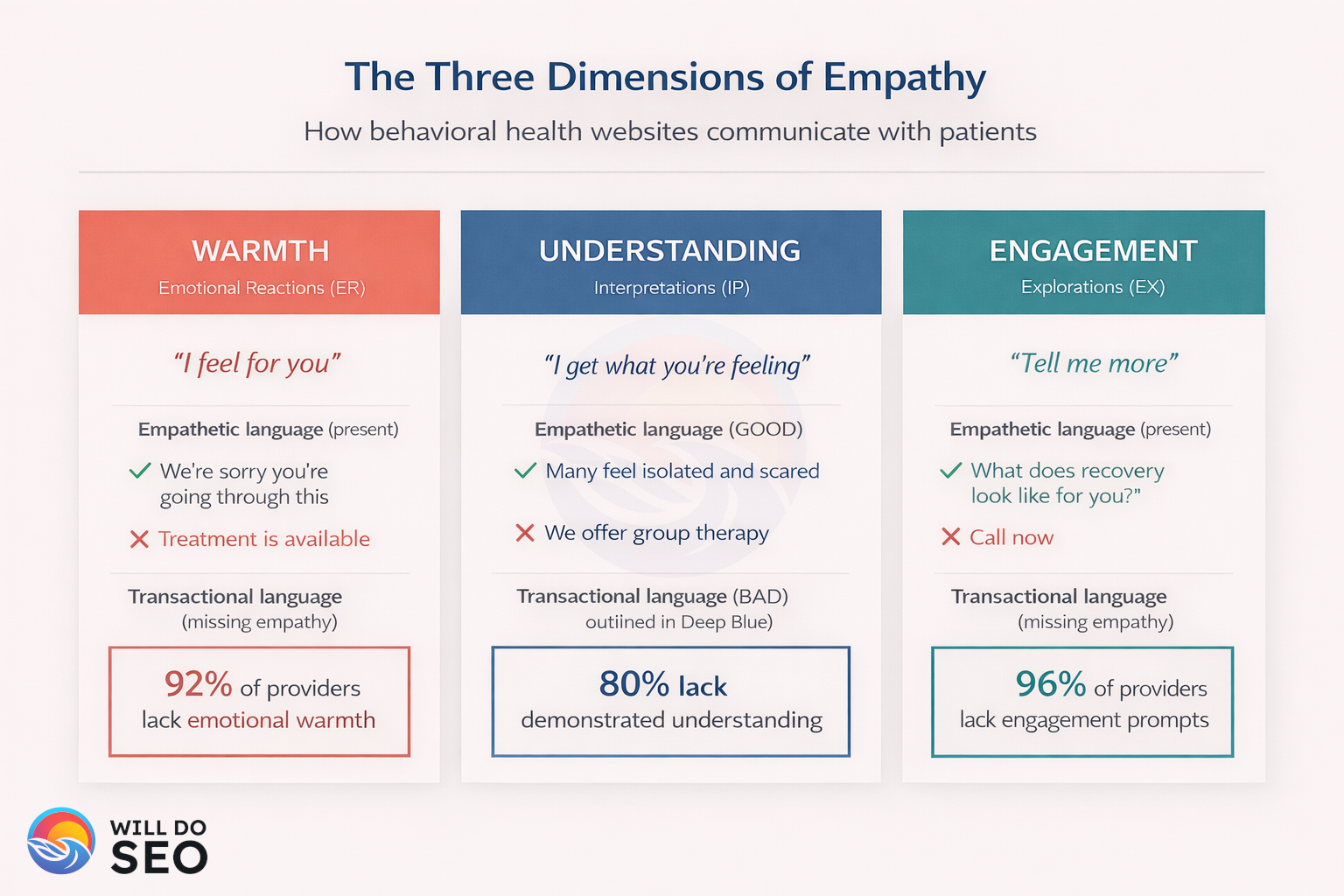
Warmth (Emotional Reactions)
What it measures: Expressing care, compassion, and concern for the reader
What it sounds like: “We’re sorry you’re going through this” or “You’re not alone”
Finding: 92% of pages lack it
Understanding (Interpretations)
What it measures: Acknowledging and naming the reader’s feelings or situation
What it sounds like: “Many people feel isolated and scared” or “It can be overwhelming”
Finding: 80% of pages lack it
Engagement (Explorations)
What it measures: Inviting dialogue and asking questions
What it sounds like: “What does recovery look like for you?” or “Are you ready to take the next step?”
Finding: 96% of pages lack it
Each dimension is scored on a scale of 0-2, where 0 means no expression, 1 means weak expression, and 2 means strong expression. The model achieves validation F1 scores of 0.81 for warmth, 0.80 for understanding, and 0.93 for engagement, indicating strong reliability.
What makes this framework powerful is that it captures different ways content can fail to connect. A page might explain addiction thoroughly (showing some understanding) without expressing that the writer cares about the reader’s pain (lacking warmth). Or it might be warm and understanding but never invite the reader into a conversation (lacking engagement).
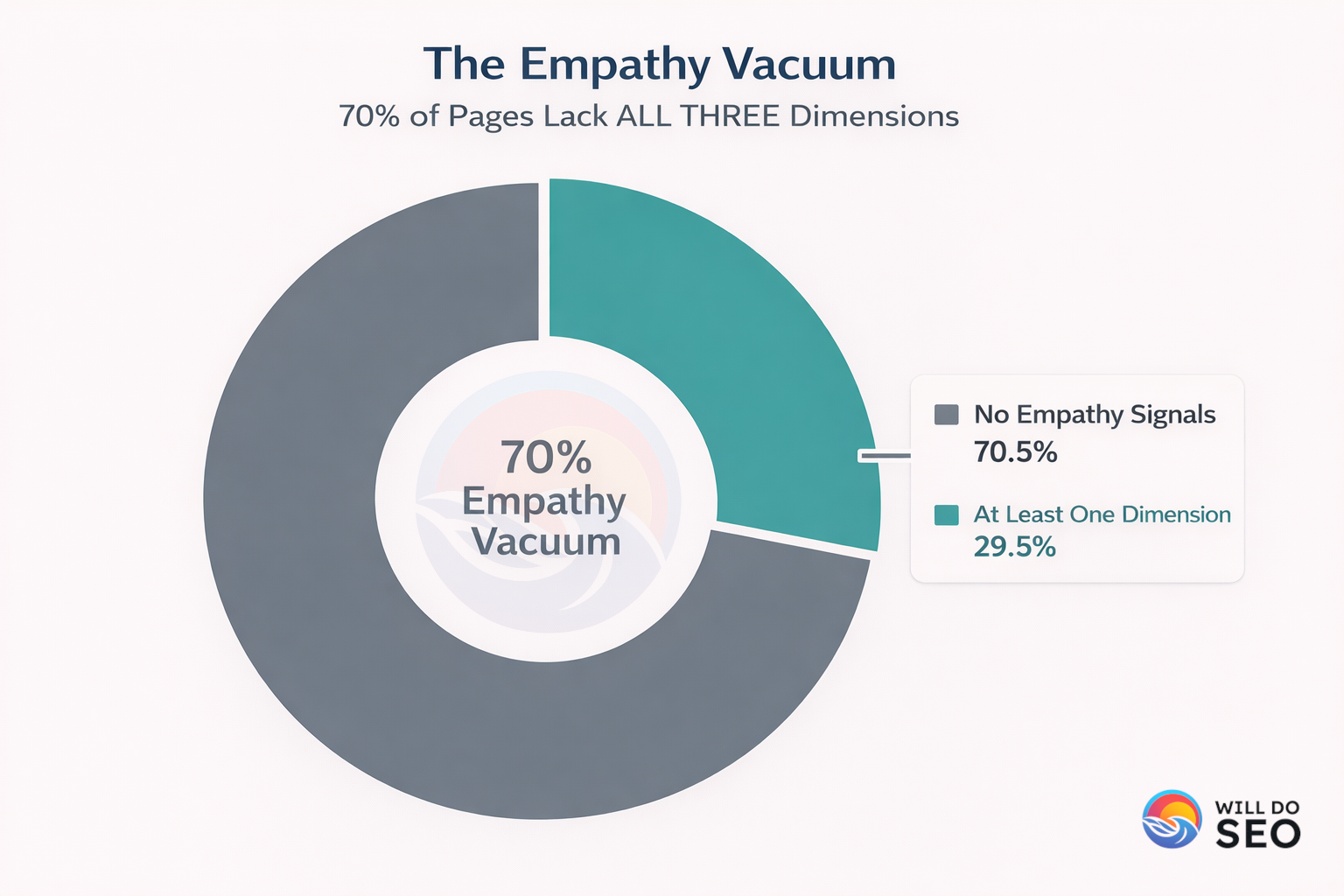
The most standout finding? 70% of pages lack all three dimensions entirely. Only 21 pages out of 85,409 (0.02%) demonstrated all three dimensions of empathy.
What the Data Shows
Here’s what I found across nearly 5,000 behavioral health providers:
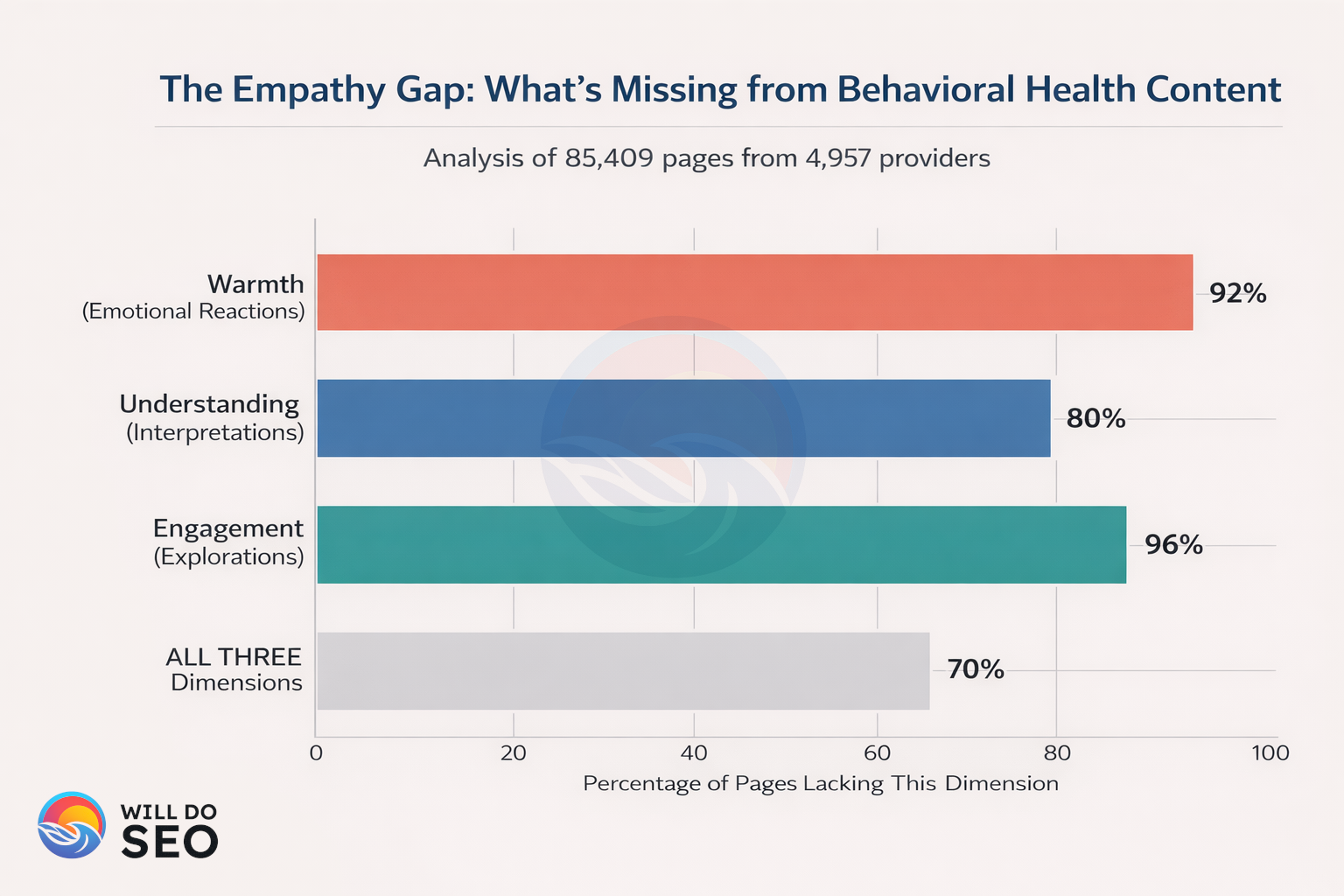
| Dimension | Pages Lacking | What It Means |
|---|---|---|
| Warmth | 92.0% | No expression of care or compassion |
| Understanding | 80.0% | No acknowledgment of feelings |
| Engagement | 96.1% | No invitation to dialogue |
| All Three | 70.5% | Complete empathy vacuum |
Looking at each dimension. Engagement is the rarest at 96% absence. Most behavioral health content is one-directional. It states what the provider offers without ever addressing the reader’s situation.
Warmth sits in the critical middle at 92% absence. The vast majority of first impressions lack any expression of care. When someone is deciding whether to pick up the phone, that missing warmth could be the difference between action and abandonment.
Understanding is most common but still 80% absent. Even the basic acknowledgment that “this is hard” or “you might be feeling scared” is missing from four out of five pages.
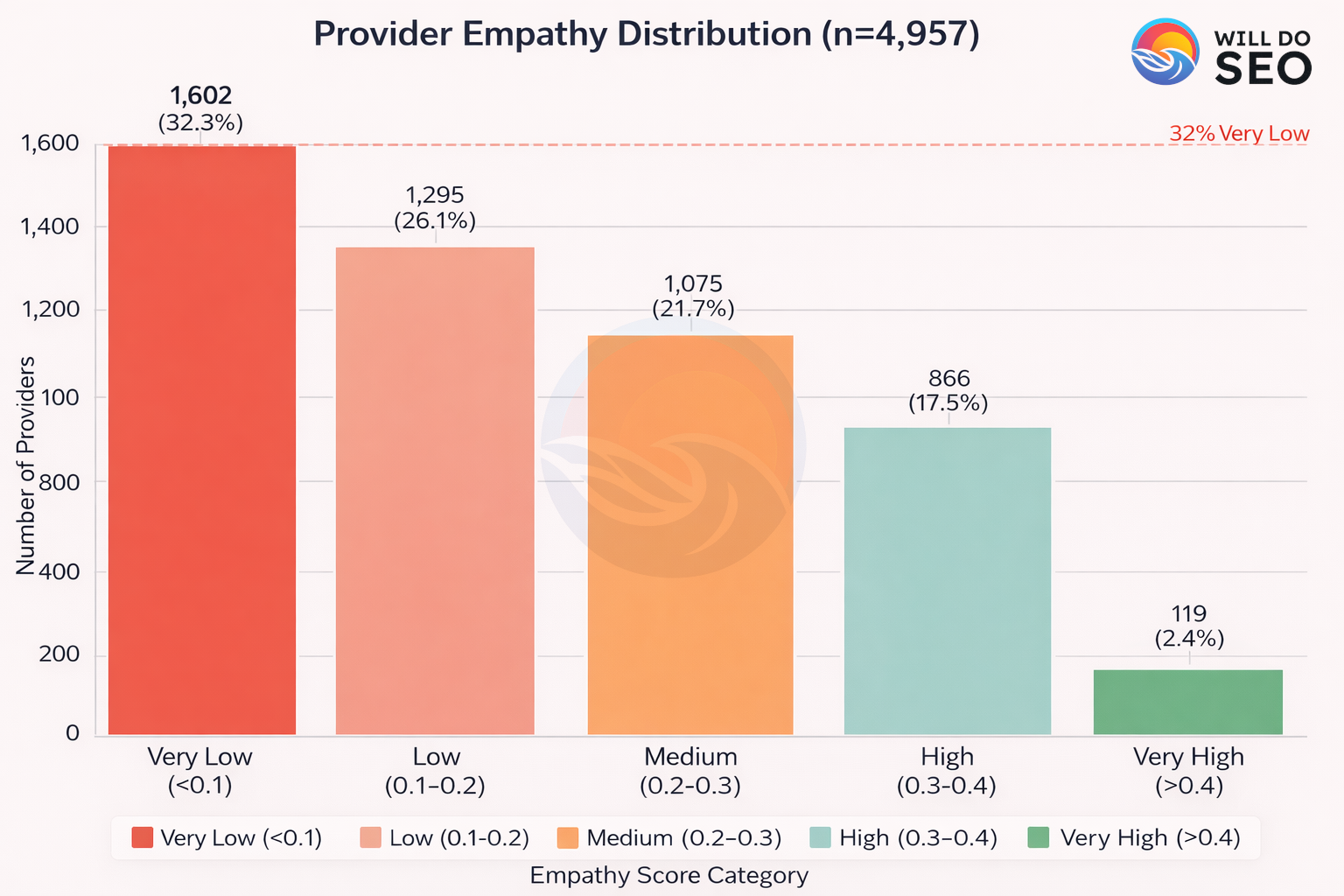
At the provider level, the distribution is equally concerning. Among nearly 5,000 providers analyzed, 32.3% scored “very low” on empathy (below 0.1 on the scale), while only 2.4% achieved “very high” scores (above 0.4). The median provider sits firmly in clinical territory.
Understanding Without Warmth
Some providers get it half right. They acknowledge what someone is going through, explain the condition accurately, describe the path forward. But they never once say: we care about you. This is understanding without warmth.
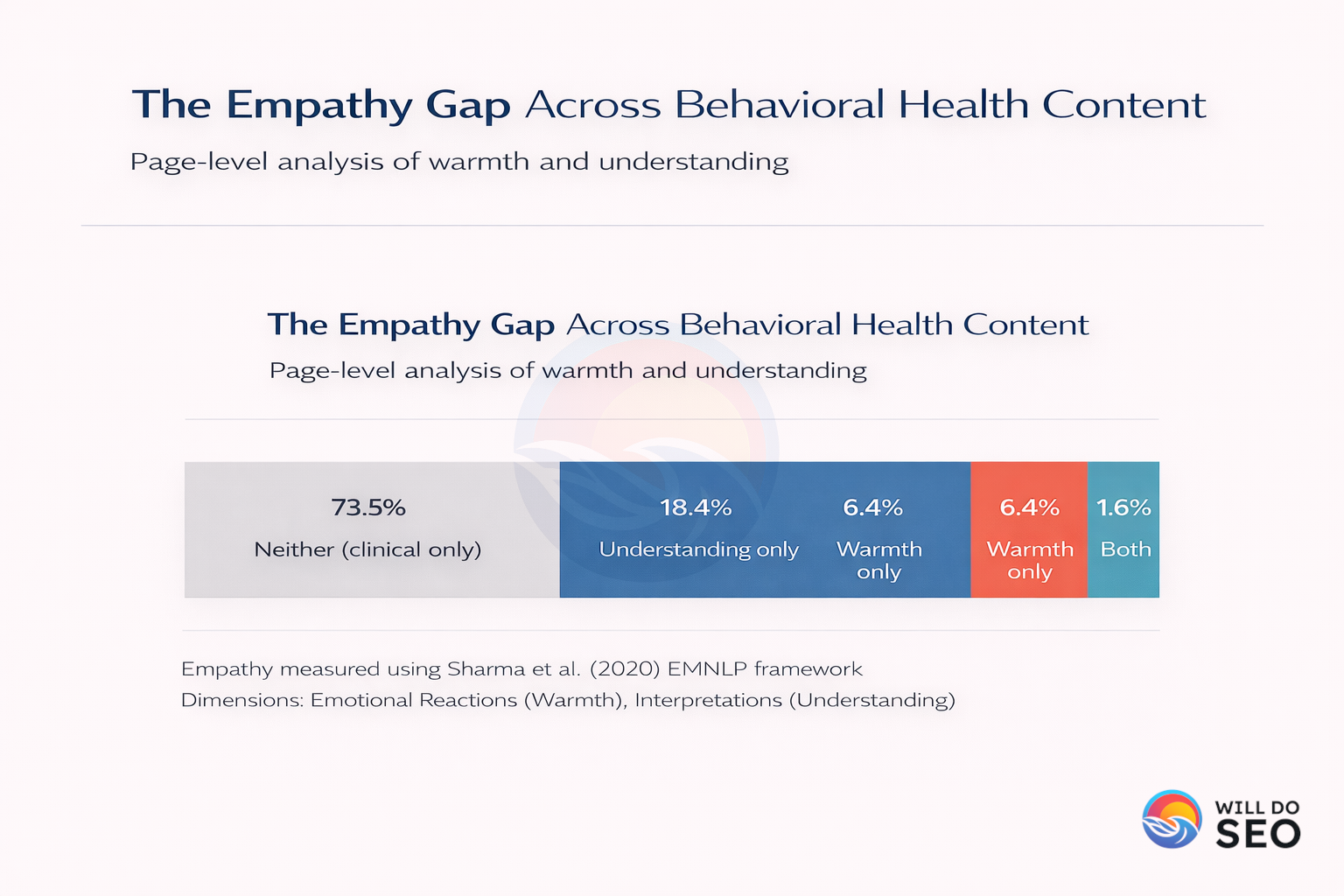
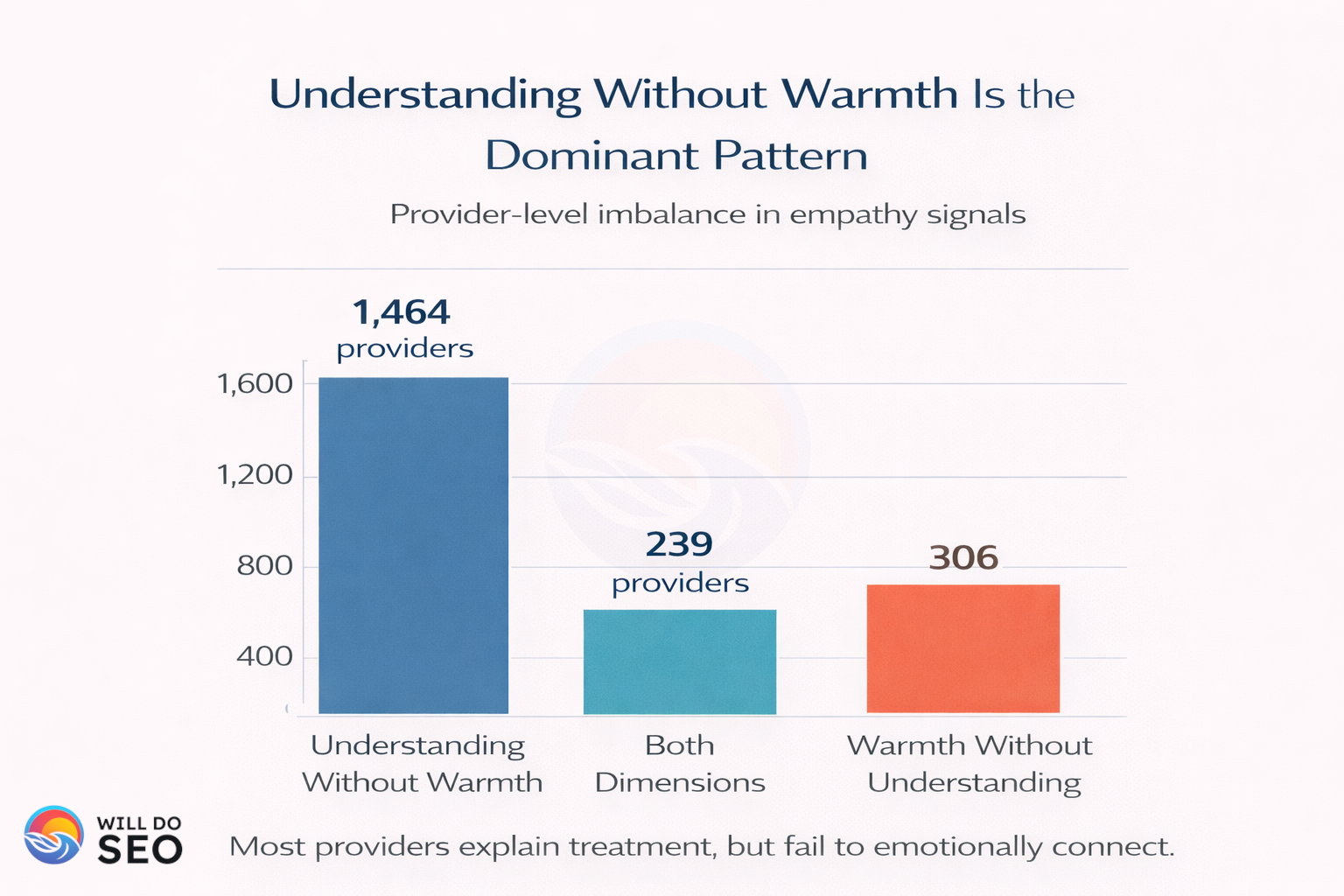
The numbers tell the story:
- 1,464 providers (29.5%) show understanding but no warmth
- 15,751 pages (18.4%) acknowledge feelings without expressing care
These pages get the clinical picture right. They might say something like:
“With the realization that recovery is a process and not an event, our social model peer-oriented and home-like recovery program is designed to assist men and women in developing a foundation for long term recovery. Our approach to recovery focuses on affecting positive change in the client’s lifestyle and behavior through education, group counseling, exposure to alternative coping skills, and positive role models.”
This content demonstrates understanding. It recognizes that recovery is a process, that change is needed, that support matters. But it never once says:
“We know how hard it is to take this first step. You’re not alone in this.”
The tone repeats across the industry:
- They describe depression without making you feel seen
- They explain addiction without acknowledging the shame
- They understand the clinical picture but miss the human one
Here’s another example from the data, a page scoring high on understanding (IP=2) but zero on warmth (ER=0):
“The Roque Center provides residential social model non-medical detoxification services for adult men and women. Services are provided in a clean, supportive, and calm environment and monitored by experienced licensed staff. Our staff is knowledgeable and trained in the recognition of and implications of symptoms arising from alcohol and drug withdrawal.”
Clinically accurate. Professionally written. Emotionally empty.
This is the content equivalent of a doctor who gives you an accurate diagnosis but never looks you in the eye. The information is correct, but the connection is missing. For someone gathering the courage to seek help, that missing warmth can feel like confirmation that they’re just a case number, not a person.
Phrases That Signal Empathy
To understand what actually differentiates empathetic content, I compared the language used in the top 10% of pages (by empathy score) versus the bottom 30%.
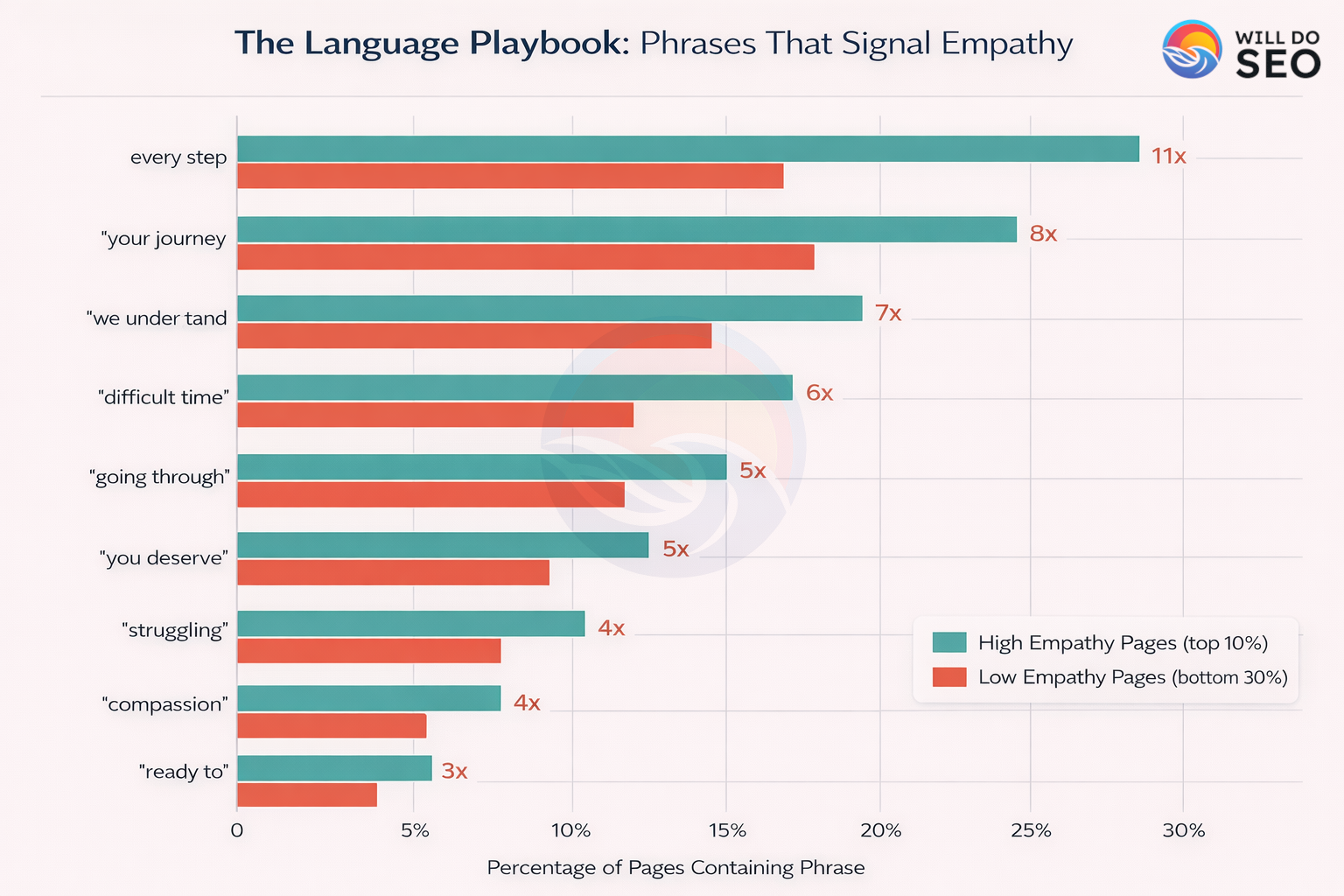
| Rank | Phrase | High Empathy | Low Empathy | Gap |
|---|---|---|---|---|
| 1 | “every step” | 10.7% | 1.0% | 11x |
| 2 | “your journey” | 11.7% | 1.4% | 8x |
| 3 | “we understand” | 11.4% | 1.7% | 7x |
| 4 | “difficult time” | 2.1% | 0.3% | 6x |
| 5 | “going through” | 4.8% | 0.9% | 5x |
| 6 | “you deserve” | 1.7% | 0.3% | 5x |
| 7 | “struggling” | 25.6% | 5.6% | 5x |
| 8 | “compassion” | 25.3% | 6.6% | 4x |
| 9 | “ready to” | 18.1% | 5.4% | 3x |
| 10 | “feeling” | 24.8% | 7.6% | 3x |
- Warmth phrases like “every step,” “your journey,” and “we understand” acknowledge that recovery is personal and that the provider will be there throughout.
- Understanding phrases like “going through,” “difficult time,” and “struggling” name the reader’s emotional state.
- Engagement phrases like “ready to” invite the reader to take action on their own terms.
Here’s what this looks like in practice:
Service Description
❌ Low Empathy:
“We offer comprehensive treatment for substance use disorders including detox, residential, and outpatient programs.”
✅ High Empathy:
“We understand how hard it is to ask for help. Recovery is possible, and we’re here every step of the way, from detox through long-term support.”
Facility Description
❌ Low Empathy:
“Our facility provides evidence-based care developed from best practices in behavioral health treatment.”
✅ High Empathy:
“Many people going through what you’re experiencing feel scared and alone. You deserve support that meets you where you are, with care that’s proven to work.”
About Page
❌ Low Empathy:
“Founded in 1998, our organization has served over 10,000 clients with an 85% completion rate.”
✅ High Empathy:
“For over 25 years, we’ve walked alongside people just like you. People who felt hopeless but found their way back. Your journey matters to us.”
Admission Information
❌ Low Empathy:
“To begin the admission process, contact our intake coordinator during business hours.”
✅ High Empathy:
“Taking this step isn’t easy, and we’re honored you’re considering us. Whenever you’re ready, day or night, we’re here to talk through your options.”
Notice that the high-empathy versions don’t sacrifice accuracy or professionalism. They simply add a human layer that acknowledges the reader’s emotional reality.
What Good Looks Like
So what does it look like when a provider gets it right? Here’s content from one of the highest-scoring pages in the analysis (empathy score: 0.645):
“You’re not alone, and there is hope. At Buena Vista Health and Recovery Centers, we help you heal your body, mind, and spirit through our compassionate, personalized continuum of care. Lasting recovery is possible. We are here to support you every step of the way.“
Here’s why this works across all three dimensions:
- Warmth: “You’re not alone” and “we are here to support you” express genuine care for the reader. The content doesn’t just describe services. It reaches out emotionally.
- Understanding: “Heal your body, mind, and spirit” acknowledges that recovery is holistic, not just clinical. The phrase “there is hope” validates that the reader might be feeling hopeless and meets them there.
- Engagement: The page uses “you” and “your” throughout, creating a sense of direct conversation. “Every step of the way” implies an ongoing relationship, not a transaction.
Compare that to this low-empathy page (score: 0.021) from the data:
“Our Training Institute Director speaks with Minnesota Medicine Magazine about strategies for effective patient communication. He emphasizes the importance of cross-cultural communication skills, being conversational, versus transactional, and avoiding generalizations.”
The irony is almost painful. This page is about the importance of being conversational rather than transactional while being entirely transactional in its own communication. It demonstrates understanding of the concept without applying it.
Why This Matters
Mental health is inherently emotional. The decision to seek help, whether for addiction, depression, anxiety, or any behavioral health challenge, is one of the most vulnerable moments in a person’s life. The content they encounter online can either validate that vulnerability or dismiss it.
Consider the context: Someone searching “signs of alcohol addiction” at 2 AM isn’t doing academic research. They’re scared. They might be drunk. They might have just had a fight with their spouse or realized they can’t stop. The first digital touchpoint might be the only one before they close the browser and convince themselves they’re fine.
Research supports what intuition suggests: empathetic communication improves treatment outcomes. When patients feel understood and cared for, starting from their first interaction, they’re more likely to engage with treatment, stay in treatment, and achieve lasting recovery. 2-3
Yet 92% of the industry’s online content fails to express basic warmth. The pages that should say “we see you, and we’re here” instead say “we offer comprehensive evidence-based treatment modalities.”
Trust is built through connection, not just credentials. A potential patient reading your website isn’t evaluating your clinical protocols. They’re trying to answer one question: “Will these people understand me?”
When your content is clinically accurate but emotionally absent, the answer feels like “no.”
The Opportunity
Here’s the silver lining in this data: the bar is remarkably low.
When 92% of your competitors fail to express warmth, showing genuine care becomes a massive differentiator. You don’t need to rebuild your website or invest in new technology. You need to rewrite with the reader’s emotional state in mind.
Adding empathy is free. It’s a writing choice, not a feature. The same page that currently says “Contact our intake coordinator” could say “Whenever you’re ready, we’re here.” The cost is zero. The impact could be significant.
Consider the gap: If you’re competing for visibility and conversions in a space where 70% of providers have zero empathy signals, simply adding warmth, understanding, and engagement to your content puts you in rare territory. You become one of the 2.4% scoring “very high” on empathy, not through massive investment, but through intentional language.
The transformation isn’t complicated. Take your top five pages: homepage, services, about us, admissions, contact. Read them through the lens of someone who is scared, ashamed, and hoping someone will understand. Then rewrite accordingly.
Three-Questions To Ask
“Compassionate care” should be in your content, not just your tagline.
Before publishing any patient-facing page, ask three questions:
- Does this show Warmth? Do we express care? Does the reader feel that we genuinely want to help them?
- Does this show Understanding? Do we acknowledge their feelings? Does the reader feel seen and validated?
- Does this show Engagement? Do we invite dialogue? Does the reader feel like we’re starting a conversation, not delivering a lecture?
If the answer to any of these is “no,” you have an opportunity to connect more deeply with people who desperately need to feel understood.
The 92% statistic isn’t an indictment. It’s an invitation. The behavioral health industry does transformative, life-saving work every day. The challenge is making sure your content reflects the compassion that happens inside your walls.
Because someone is searching right now. They’re scared. They’re hoping someone will understand.
Make sure your content answers: “We do.”
Citations & References
- Sharma, A., Miner, A.S., Atkins, D.C., & Althoff, T. (2020). A Computational Approach to Understanding Empathy Expressed in Text-Based Mental Health Support. Proceedings of the 2020 Conference on Empirical Methods in Natural Language Processing (EMNLP). https://aclanthology.org/2020.emnlp-main.425/
- Howick, J., Moscrop, A., Mebius, A., et al. (2018). Effects of empathic and positive communication in healthcare consultations: a systematic review and meta-analysis. Journal of the Royal Society of Medicine, 111(7), 240-252. https://doi.org/10.1177/0141076818769477
- Derksen, F., Bensing, J., & Lagro-Janssen, A. (2013). Effectiveness of empathy in general practice: a systematic review. British Journal of General Practice, 63(606), e76-e84. https://doi.org/10.3399/bjgp13X660814
WillDoSEO.com
Powered By Espresso ☕️